
Views: 140
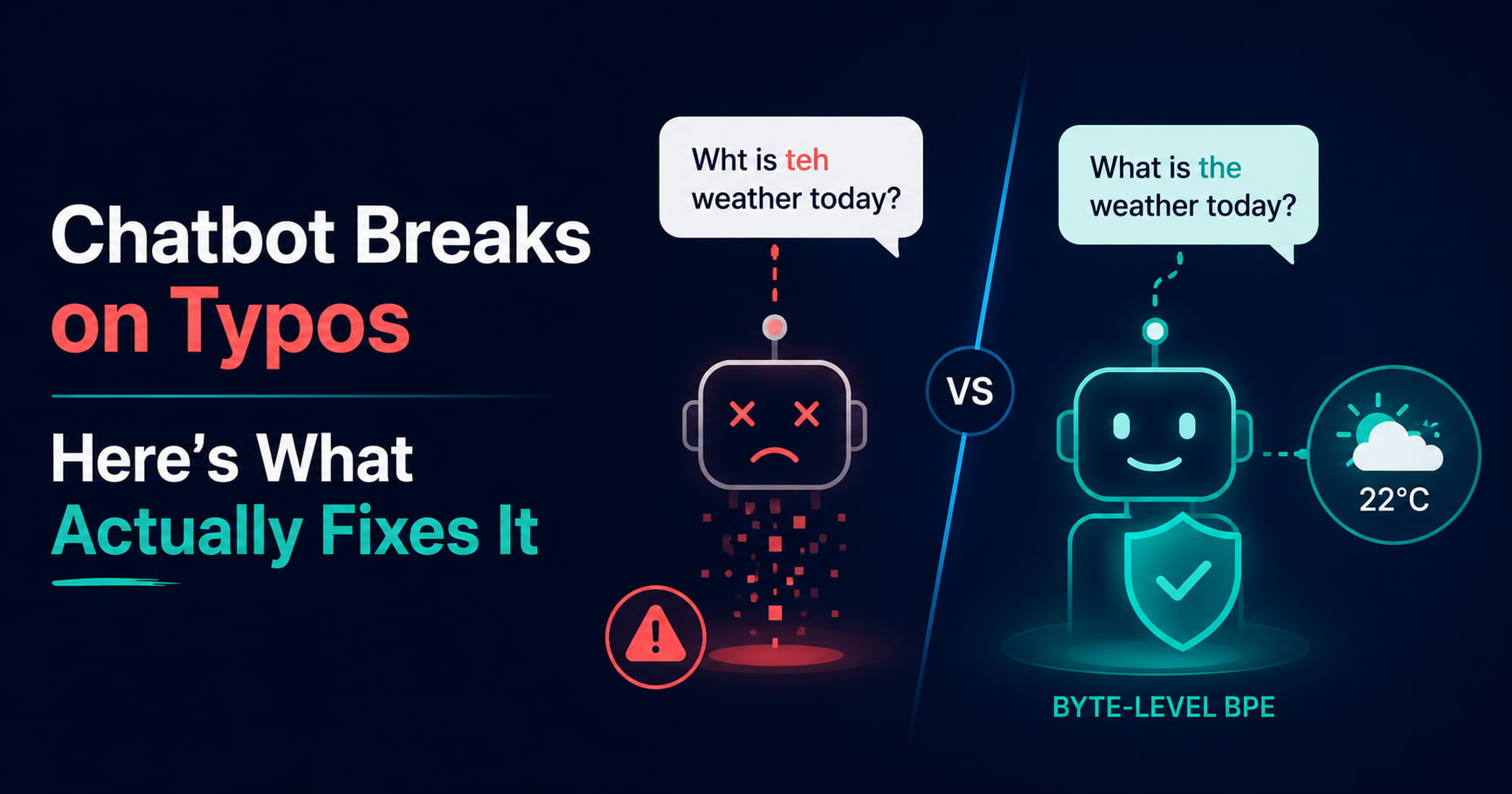
A single misspelled word can silently degrade an LLM application’s output. Here’s what’s actually happening under the hood, and why byte-level BPE tokenization — not better prompting — is the real fix.
A user types “recieve” instead of “receive.” A product name gets typo’d in a support ticket. A user pastes text with an unusual Unicode character from a different keyboard layout. In a surprising number of production LLM applications, these small, human, entirely expected mistakes cause noticeably worse output — not because the model “doesn’t understand typos” in some vague sense, but because of something specific and fixable happening at the very first step of the pipeline, before the model ever sees a single embedding.
It’s not the model. It’s the tokenizer.
Before any text reaches an LLM’s actual reasoning, it passes through a tokenizer — the component that breaks raw text into the discrete units (tokens) the model actually operates on. Older, naive approaches split text on whitespace into whole words, matched against a fixed vocabulary. The problem: any word not in that vocabulary — a typo, a brand-new product name, a rare technical term — either gets dropped, mangled into an [UNK] placeholder, or handled by some brittle fallback rule. The model doesn’t get a “confusing” version of the word. It gets no meaningful version of the word at all.
Modern LLMs solve this with subword tokenization, and specifically a family of algorithms descended from Byte-Pair Encoding (BPE) — originally a 1994 data-compression algorithm, adapted for language models in 2016, and refined into a byte-level form for GPT-2 onward. Instead of a fixed dictionary of whole words, the tokenizer builds its vocabulary from statistically common fragments — pieces smaller than a word, learned directly from data. “Tokenization” itself decomposes into recognizable pieces like token and ization. Crucially, a byte-level base vocabulary — literally every possible byte value, 0 through 255 — means no input can ever be fundamentally unrepresentable, no matter how unusual, no matter what language, no matter how mangled the spelling.
Why this still isn’t the whole story
Solving symbol-level representation isn’t the same as solving meaning. A misspelled or genuinely novel word still gets broken into fragments the tokenizer has never combined in exactly that way before — and how well the model handles that depends on whether the embeddings sitting behind those fragments were built to compose, not just to exist. This is where architectures like fastText made a real, practical difference: representing a word’s meaning as the sum of its subword fragments’ meanings, rather than one atomic lookup, means a word the model has genuinely never encountered can still land close to related, known words — because it shares recognizable pieces with them. A tokenizer without this property can still turn a typo into valid tokens; those tokens just won’t carry any useful signal about what the word was trying to mean.
The practical takeaway
If an LLM-powered product is behaving inconsistently on messy, real-world user input — typos, brand names, code-mixed text, unusual formatting — the instinct is usually to fix it with better prompting or more examples. Worth checking first: what tokenizer is actually running, and whether the vocabulary and embedding strategy behind it were built to degrade gracefully on the unfamiliar, or to simply fail on it. The gap between those two is often the entire difference between a system that’s robust in production and one that only ever looked robust in a clean demo.
Detailed Understanding on the Topic
To learn the concept in depth please follow these dedicated blog posts:
What is tokenization? and Byte Pair Encoding
You can also follow our detailed blog post series called From Zero to Agents where we are explaining all concepts in three dimensions i.e. 1) Theoratically 2) Mathematically and 3) Programmatically from scracth.
Leave a Reply